
Warning Signs your Deck is no longer Structurally Safe
Your deck is one of the most used spaces in your home, but it is also one of the most overlooked when it comes to structural maintenance. Most homeowners notice when a board looks worn or the paint is peeling, but the warning signs that actually matter, the ones that indicate a deck is no longer safe to use, are often hidden from plain sight until the damage is already serious.
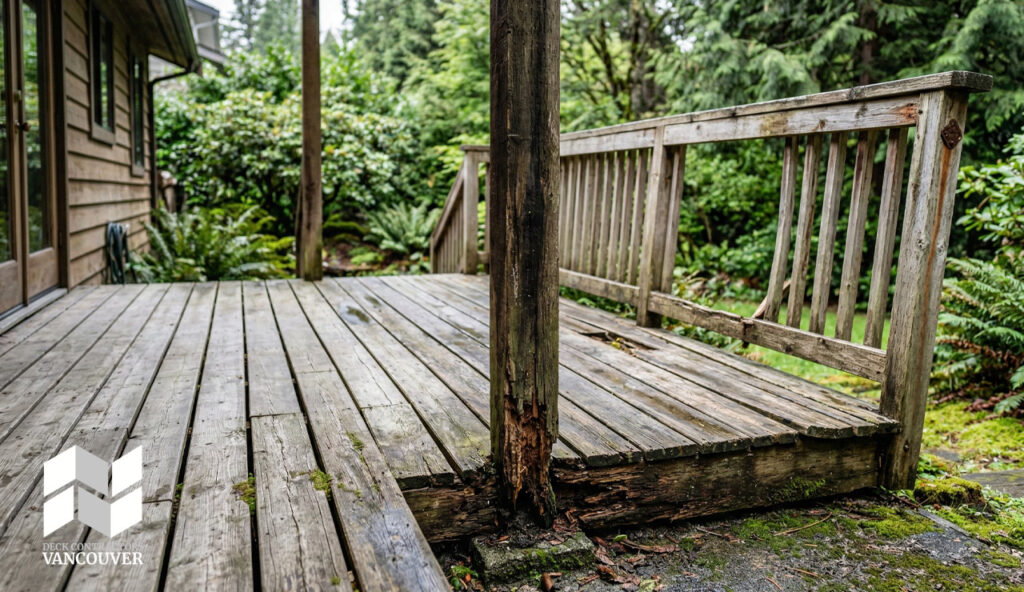
In Vancouver and the surrounding communities, the combination of heavy rainfall, high humidity, and seasonal temperature swings means that decks age faster than in most other parts of the country. This guide walks you through the key signs your deck may no longer be structurally sound, and what to do when you spot them.
Why deck safety matters more than most homeowners think
Deck collapses rarely happen without warning. In most cases, the structure has been sending signals for months or even years before a serious failure occurs. The problem is that many homeowners either overlook these early signs or assume that what they are seeing is purely cosmetic. A few cracks in the wood or some surface discoloration can feel like minor issues, but beneath the surface, the structural integrity of the deck may already be compromised. Understanding the difference between a cosmetic problem and a structural one is the first step toward keeping your family safe.
In Vancouver and across the Lower Mainland, decks face conditions that accelerate deterioration far faster than in drier climates. The combination of heavy rainfall, high humidity, and seasonal temperature changes creates an environment where wood rots, fasteners corrode, and footings shift more quickly than most people expect. This means that a deck which looks fine from the outside may already have serious damage in the components you cannot easily see, such as the ledger board, the joists, or the support posts. Knowing when a deck needs a simple repair versus a full replacement can save you money in the long run and, more importantly, prevent an accident that should never happen.
Signs your deck is no longer structurally safe to use
You do not need to be a contractor to spot early warning signs of deck failure. A basic visual inspection involves walking the deck slowly and paying attention to how it feels underfoot, checking for visible damage on posts, boards, and railings, and looking underneath the structure when possible.
Rotting or soft posts and beams
The posts and beams are the foundation of everything your deck stands on, and when they begin to fail, the entire structure becomes unsafe. Rot on support posts often feels soft or spongy when pressed, and you may notice dark discoloration, crumbling wood fibers, or a musty smell near the base. What makes this particularly dangerous is that rot typically begins from the inside out, meaning the damage is often far more advanced than what is visible on the surface.
In Vancouver, where posts are exposed to persistent moisture and rainy seasons that can last for months, this type of deterioration happens faster than in drier regions. If you press on a post and it gives way even slightly, or if you notice that the deck wobbles when you walk across it, do not attempt to assess the full extent of the damage yourself. This is the point where a professional inspection is not just recommended, it is necessary.
A ledger board that has pulled away or shows water damage
The ledger board is the horizontal piece of lumber bolted directly to your home that anchors one full side of your deck, making it arguably the most important structural connection point on the entire structure. When the ledger fails, the deck can separate from the house entirely, which is one of the most common causes of sudden and complete deck collapse.
Visual warning signs include rust streaks running down your siding, water staining below the connection point, visible gaps between the ledger and your home’s exterior, or any movement in the deck near the house wall. Many of these failures trace back to improper or missing flashing installed during the original build, which allows water to penetrate behind the ledger over time. Beyond the deck itself, a deteriorating ledger can allow moisture to travel into your home’s framing, leading to damage that extends well beyond the deck repair budget.
Loose or wobbly railings
Railings are not decorative trim. They are a critical safety system designed to prevent falls, and in British Columbia, the Building Code requires them to withstand significant lateral force without giving way. A simple way to test your railings is to stand at arm’s length and push firmly from side to side on the top rail.
There should be no movement at all. If a railing shifts, wobbles, or feels unstable under moderate pressure, it represents a real fall hazard for anyone using the deck. Beyond the push test, look for cracked or split wood at post bases, corroded fasteners, spindles that are loose or missing, and posts that lean even slightly away from vertical. These are signs that go beyond normal wear and point to a railing system that can no longer be trusted to do its job.
Widespread wood rot across the deck surface
Replacing one or two damaged boards is a routine repair that most homeowners can plan for without concern. The situation becomes more serious when rot appears across multiple boards in different areas of the deck, which is a pattern that often indicates a deeper moisture problem affecting the structure below the surface.
When surface boards show widespread decay, there is a strong likelihood that the joists underneath have also been exposed to the same moisture conditions and are experiencing similar deterioration. Patching individual boards in this scenario provides a short-term cosmetic fix while the underlying structural damage continues to worsen. As a general rule, when more than a quarter of your deck boards show signs of rot or soft spots, the cost and disruption of ongoing repairs will typically exceed the investment of a full replacement, and the result will be far more reliable.
Sinking or cracked footings
Deck footings are the concrete bases buried in the ground that transfer the entire weight of your deck into the soil below. When they crack, shift, or sink, nothing above them remains stable. Signs of footing failure are often visible at the deck surface level before you ever look underground. An uneven or noticeably sloping deck, gaps forming between posts and beams, or a deck that seems to have shifted position seasonally are all indicators that the footings may be compromised.
In Vancouver and the surrounding Lower Mainland, the combination of clay-heavy soils, high groundwater levels, and freeze-thaw cycles during colder months creates conditions that place unusual stress on footings over time. Older decks are particularly vulnerable because many were built with footings that did not meet current depth or sizing requirements. When footings fail, the repair path almost always leads to full replacement, since correcting a footing problem requires dismantling the structure above it.
Failing or sagging joists
Joists are the horizontal framing members that run beneath your deck boards and carry the load across the span of the structure. They are not visible during a surface inspection, but there are signs from above that point to joist problems. A deck that feels springy or bouncy when you walk across it, boards that are separating or popping up at the fasteners, or a visible sag in sections of the deck surface are all worth investigating further. If you are able to view the underside of your deck, look for joists that are cracked, split, discolored, or visibly bowing downward.
In Vancouver’s climate, trapped moisture between decking boards and joists is a leading cause of accelerated rot in this part of the structure. Many older decks were also built with joist spacing that does not meet modern standards, meaning they may already be carrying more load than they were designed to handle as the wood weakens with age.
A deck that has simply reached the end of its lifespan
Every deck has a natural lifespan that depends on the materials used, the quality of the original build, and how well it has been maintained over the years. In Vancouver’s wet climate, pressure-treated pine typically lasts between 10 and 15 years, cedar between 15 and 20 years, and composite decking materials can reach 25 to 30 years or more with proper care. Even when a deck does not show dramatic visible damage, age alone is a legitimate safety concern.
Wood that has gone through years of wet and dry cycles becomes increasingly brittle and less predictable under load, even if it still looks acceptable on the surface. If your deck is approaching or has passed the expected lifespan for its material type and is also showing one or more of the warning signs described above, continuing to repair it is likely to cost more over time than investing in a replacement built to current code standards with materials suited for the local climate.
When to repair and when to Replace your Deck?
Not every deck problem calls for a full replacement. A simple way to approach the decision is to look at three things together: how many areas are affected, how old the deck is relative to its expected lifespan, and whether the damage involves structural components like posts, joists, or the ledger board. When damage is isolated, the deck is relatively young, and no structural parts are compromised, a targeted repair is usually the right call.
When multiple warning signs appear at the same time, replacement almost always makes more sense than repair. Structural problems rarely travel alone. A deck with ledger issues often has fastener corrosion throughout. A deck with surface rot usually has joist damage underneath. Addressing each problem individually adds up quickly, and those repairs do not stop the rest of the structure from continuing to deteriorate.
The numbers also matter when making this decision. Repeated repairs on an aging deck accumulate into a significant expense without improving its long-term safety or lifespan. A new deck built to current BC Building Code standards can serve your home for 25 to 30 years with minimal maintenance. At Deck Contractors Vancouver, we provide professional inspections that give you an honest picture of your deck’s condition, so you can make a clear and informed decision.
How to keep your new deck structurally safe for years
Once your deck is built, a few consistent habits go a long way toward protecting its structural integrity over time. Clearing debris from between deck boards after heavy rain, checking for standing water after storms, and doing a quick visual inspection of posts, railings, and the ledger connection each spring are simple routines that catch small problems before they become expensive ones. Applying a quality sealant to wood surfaces every one to two years also makes a meaningful difference in how well the material holds up against Vancouver’s wet seasons.
The materials used and the quality of the original installation have the greatest influence on how long a deck stays safe and sound. Composite decking, proper flashing at the ledger, stainless steel or hot-dipped galvanized fasteners, and footings poured to the correct depth for local soil conditions all reduce the risk of the structural failures described above. At Deck Contractors Vancouver, every build follows BC Building Code requirements from the ground up, because code-compliant construction is not just a legal standard, it is the foundation of a deck that performs reliably for decades.
Get a professional deck inspection in Vancouver
A professional deck inspection goes well beyond what a homeowner can assess during a casual walkthrough. A qualified contractor examines the components that are not easily visible, including the condition of the ledger connection, the integrity of joists and beams, the depth and stability of footings, and whether the overall structure meets current BC Building Code requirements. This level of assessment gives you an accurate picture of where your deck actually stands, not just how it looks on the surface.
At Deck Contractors Vancouver, we inspect every structural element with the same attention we bring to a new build. If your deck needs repair, we will tell you exactly what is required. If replacement is the safer and smarter path, we will explain why in plain terms. Reach out to our team today to schedule your inspection and get the honest assessment your deck deserves.