
How Deck Lighting Improves Safety and Aesthetics on Any Outdoor Space?
Most homeowners spend months choosing the right decking material, railing style, and layout for their outdoor space. Lighting, if it gets considered at all, usually ends up as a last-minute addition. In our experience building decks across Vancouver and the surrounding communities, that order of priorities is one of the most common and costly mistakes we see. The way a deck is lit determines how safe it is, how long it gets used each day, and how impressive it looks from the street.
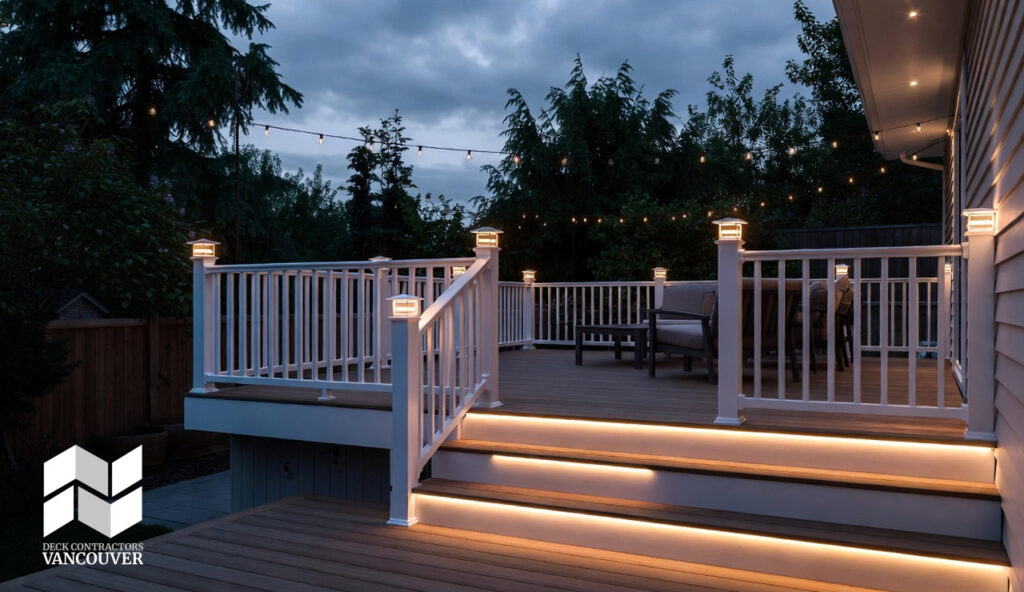
In this guide, we want to walk you through everything that good deck lighting actually does for your home. Whether you are planning a new build, renovating an existing deck, or simply looking to get more out of your outdoor space, understanding how lighting works will help you make smarter decisions from the start. The difference between a deck that gets abandoned after sunset and one that becomes your favorite room in the house often comes down to light.
Why Deck Lighting Matters more than most Homeowners think?
When we build or renovate a deck, most of the attention goes to materials, layout, and railing styles. Lighting often gets treated as an afterthought, something to figure out later. But in our experience working with homeowners across Vancouver, the ones who plan their lighting from the start are always the ones who get the most out of their outdoor space. A deck without proper lighting is essentially a space you stop using the moment the sun goes down.
What many people do not realize is that exterior lighting ranks among the top features home buyers look for when evaluating a property. Beyond resale value, good deck lighting changes how your family and guests feel in the space. A dark deck feels uninviting and even unsafe, while a well-lit one feels like a natural extension of your home. It signals that the space is designed to be lived in, not just looked at from inside.
How Deck Lighting Improves Safety on Stairs, Paths and Railings?
One of the most practical reasons to invest in deck lighting is safety. Stairs, edges, and transition points on a deck are exactly where accidents happen after dark, and proper lighting is the most effective way to prevent them. When we design a deck lighting plan, safety zones always come first.
Stair and Tread Lighting
Unlit stairs are the most common source of nighttime trips and falls on outdoor decks. The problem is not just the darkness itself but the way shadows fall across steps, making it hard to judge depth and distance. Riser lights and tread lights solve this by casting a low, directed glow right where the foot lands, illuminating each step clearly without producing the harsh glare that actually makes visibility worse.
It is also important to light the top and bottom of the staircase, not just the steps in between. Those two transition points are where people hesitate and misjudge footing the most. For households with young children, elderly family members, or anyone moving between the deck and the yard while carrying food or chairs, this kind of deliberate stair lighting is not optional. It is one of the most valuable safety decisions a homeowner can make.
Post and Railing Lighting
Post cap lights and accent lights do more than add visual appeal. They define the perimeter of the deck and mark its edges clearly, which is especially important on elevated structures where a misstep has real consequences. Placed at regular intervals along the railing, they give anyone on the deck a clear sense of where the space ends.
One thing we always explain to clients is the difference between eye-level lighting and low-mounted lighting. Fixtures placed at eye level tend to create glare and actually reduce your ability to see the deck surface clearly. Low-mounted post lights, positioned to wash light downward across the deck boards and rails, provide much better visibility and comfort. When choosing post lighting, the angle and mounting height matter just as much as the brightness, and getting those details right is what separates a safe deck from one that only looks lit.
How Deck Lighting Transforms the Look and Feel of Your Outdoor Space?
Safety is the foundation of a good lighting plan, but aesthetics are what make a deck truly memorable. The right lighting does not just help people see, it shapes how the entire space feels after dark. In our work across Vancouver and the surrounding area, we have seen modest decks become stunning outdoor rooms simply because the lighting was thoughtfully designed.
Ambient Lighting for Atmosphere
String lights and lanterns are among the most effective tools for creating warmth on a deck. They produce a soft, diffused glow that feels relaxed and welcoming, exactly the kind of atmosphere you want when entertaining friends or spending a quiet evening outside. Beyond the overall mood, ambient lighting can also define zones within the deck, a dining area, a lounge corner, a conversation space, each with its own feel without physical dividers.
Color temperature plays a bigger role than most people expect. Warm white tones, typically in the 2700K to 3000K range, create a cozy, inviting look that complements wood tones and natural materials beautifully. Cooler whites can feel clinical and harsh in a residential outdoor setting. Choosing the right temperature is one of the simplest decisions you can make, and it has an immediate impact on how polished and appealing the space looks, both to your family and to anyone seeing your home from the street.
Accent Lighting for Architectural Features
Uplights and downlights allow us to highlight the details that make a deck worth noticing. A well-placed uplight can draw attention to a post, a pergola column, or a garden bed alongside the deck, adding depth and visual interest that flat, uniform lighting simply cannot achieve. Downlighting from overhead fixtures or the underside of a beam creates a layered effect that gives the space dimension and a more finished, designed appearance.
This layering technique is something we rely on heavily in our deck projects. When you combine ambient, accent, and task lighting thoughtfully, the result feels intentional rather than installed. It is also worth noting that quality materials like composite decking and detailed railings deserve light that shows them off properly. A warm, angled light across the deck surface reveals texture and craftsmanship in a way that flat overhead lighting never will. The goal is always to enhance, not overwhelm. Over-lighting a deck strips it of elegance and gives it the look of a parking lot rather than a living space.
The Best Types of Deck Lighting Fixtures and When to Use Each
There are more fixture options available today than ever before, and that variety is genuinely useful once you understand what each type is designed to do. Post cap lights sit on top of railing posts and provide general illumination across the deck perimeter. Riser lights install directly into stair risers to light each step from below.
Under-rail lights tuck beneath the top rail to cast a soft glow along the railing line. In-deck lights are recessed into the deck surface itself, ideal for marking edges and pathways. String lights hang overhead and contribute atmosphere more than directed light. Each type has a specific role, and the best decks use several of them together.
When it comes to power source, the choice between low-voltage LED systems and solar-powered fixtures depends largely on your deck layout and access to wiring. Low-voltage LED lighting connects to your home’s electrical system and delivers consistent, reliable output regardless of weather or season, which makes it the stronger choice for stairs and any area where dependable visibility matters.
Solar-powered fixtures work well in supplementary roles, along a garden path or as decorative accents in spots where running wire would be difficult or costly. In Vancouver’s climate, where overcast days are common for stretches of the year, we generally advise against relying on solar alone for your primary lighting needs.
The decision between permanent and temporary installation is one worth making early, ideally before the deck is built or during a resurfacing project. Permanent fixtures integrated into the structure during construction look cleaner, perform better, and require less maintenance over time. Temporary options like plug-in string lights or solar post caps offer flexibility and lower upfront cost, and they work well as a complement to a permanent system. The most effective approach is to plan your permanent lighting for safety-critical zones first, then layer in temporary or decorative fixtures to build atmosphere around that foundation.
Planning Your Deck Lighting Layout Before You Start
A lighting plan works best when it is developed before any fixtures are purchased or wires are run. Thinking through the layout in advance saves money, avoids rework, and produces a result that feels cohesive rather than pieced together. We always recommend treating the lighting design as part of the deck design, not something to figure out after the build is done.
Key Zones to Prioritize
Not all areas of a deck carry the same lighting priority. Stairs and entry points come first because they present the highest safety risk after dark. The perimeter edge is next, followed by task zones like a grilling station or outdoor dining area where people need enough light to see what they are doing comfortably. Decorative and accent lighting fills in around those foundations. Mapping this hierarchy before selecting fixtures helps avoid the common mistake of over-lighting some areas while leaving others dangerously dim.
It is also worth walking your deck at dusk before finalizing any plan, taking note of where shadows naturally fall and where existing structures block light. Spacing between fixtures matters more than most people realize.
Placing lights too far apart creates dark gaps that undermine both safety and visual balance, while placing them too close together produces a harsh, uneven effect. For any wired installation in Vancouver and across BC, electrical work on outdoor structures must comply with local building codes, which typically require permits and inspection for permanent low-voltage or line-voltage systems connected to your home.
DIY vs Professional Installation
There is a clear and practical line between what a homeowner can handle independently and what requires a licensed electrician. Solar-powered fixtures and plug-in string lights are genuinely DIY-friendly. They require no wiring knowledge, no permits, and can be repositioned easily. Anything that connects to your home’s electrical system, including low-voltage transformer setups and hardwired fixtures, falls into a different category entirely and should be handled by a professional.
Outdoor electrical work is unforgiving when it is done incorrectly. Moisture, temperature swings, and UV exposure put constant stress on connections and materials, and a poorly sealed junction or undersized wire can become a fire or shock hazard over time. Every fixture and connector used in an exterior installation should carry an appropriate IP rating confirming it is certified for outdoor use.
Beyond safety, there is a practical advantage to coordinating your lighting installation during the construction or renovation of the deck itself. Running conduit and placing junction boxes before decking boards go down is far simpler and less expensive than trying to retrofit wiring into a finished structure.
Simple Maintenance Tips to Keep Your Deck Lights Working Year Round
Deck lighting is a long-term investment, and like any part of your outdoor structure, it performs best when it receives basic attention on a regular basis. We recommend cleaning your fixtures at least twice a year, once in spring and once in the fall, removing dust, dirt, and any moisture that has accumulated inside lens covers or around mounting points. In Vancouver’s wet climate, this seasonal check is especially important because standing water and debris around unsealed connections accelerate corrosion faster than most homeowners expect.
At the start of each season, it is worth inspecting every connection point and gasket for signs of wear, cracking, or discoloration. LED systems are remarkably low maintenance overall, with quality drivers and diodes typically lasting 25,000 to 50,000 hours under normal conditions, but the connectors and seals around them are often what fail first. If you notice fixtures flickering, producing uneven light, or showing visible rust or moisture inside the housing, those are signals to call a professional before a minor issue becomes a wiring problem. Catching it early is always simpler and less costly than waiting until something stops working entirely.